
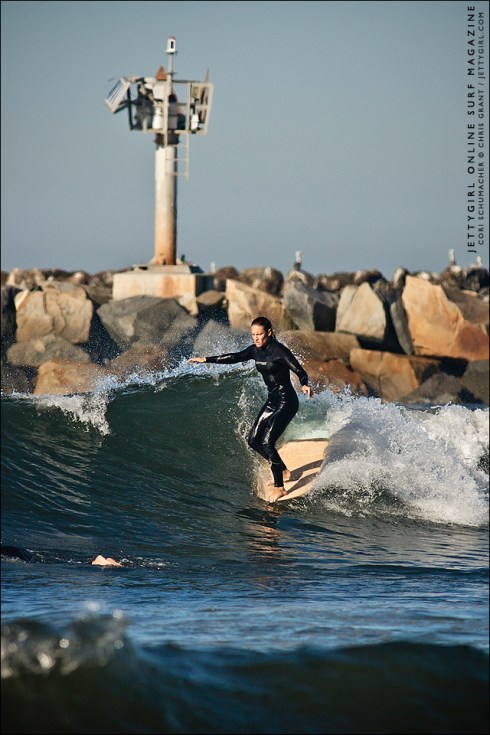
(This interview about women in surfing and my decision to boycott the ASP World Tour, was just published in the summer issue of Curl Magazine. There is no online access to this article so it is being reprinted here, with the images and captions provided in the article. I have also added links throughout the article and a video of Carissa Moore. The image above was taken by Chris Grant of Jettygirl.com and was printed in the original article.)
Cori Schumacher
Standing Her Ground
Interview by Lynne Dickinson
Actors and musicians around the world have long ago cashed in on their “movie star” status to draw the world’s attention to things they strongly believe in. Hollywood sex symbol, Brigitte Bardot, who retired from Hollywood in the early ’70s, devoted her time to animal rights and you’re likely to find a celebrity attached to nearly every “good cause” that’s out there. The star status of Angelina Jolie and U2 frontman, Bono, have allowed them to not only draw the world’s attention to the plight of people in Africa, but has also enabled them to instigate real change. The power of the rich and famous seems to have no end.
Boycotting has also been an effective way of forcing change. A sporting boycott was placed on South Africa during their apartheid policies, bringing the human rights crisis in South Africa to the forefront of global attention. And perhaps one of the most well known and successful boycotts was instigated by African/American seamstress, Rosa Parks, who upon refusing to give up her seat for a “white woman” sparked the Montgomery Bus Boycott of 1955. The boycott showed what can be achieved by simply standing together against something you strongly believe in. However, can anything really be achieved if you are standing alone?
 Earlier this year, 2010 longboarding World Champion, Cori Schumacher, chose to boycott the 2011 World Tour when they included Hainan Island, China, as one of the tour locations, Having deep reservations, both politically and personally, about being involved in anything that would benefit a country that still actively engages in human rights violations, specifically against women, Cori chose to boycott.
Yet, has her stand allowed her to achieve change or has it simply allowed her conscience to feel eased? No doubt, in the world of women’s surfing, which, let’s face it, doesn’t have a great amount of influence, she made her mark. But ahs it made the slightest bit of difference to what is happening in China? At the end of October, despite Cori’s stand, the World Longboarding Championship was still held in Hainan Island. We caught up with this articulate and inspirational woman to see if she had any regrets or if her choice had encouraged a change…

LD: With the China event just around the corner, how are you feeling about your decision to boycott the event?
CS: As the deciding event of the ASP Women’s World Longboard Championship approaches, I am feeling secure in my decision to boycott this year’s ASP world tour. What is difficult is watching my peers post pictures of the lavish accommodations they will be staying in while in China even as women are forced to undergo sterilization and abortions under the institutionalized One Child Policy; even as monks in Aba county immolate themselves in protest of the same government that will be paying for my peers accommodations and travel expenses; even as Nobel Laureate Liu Xiaobo, the first Chinese citizen to receive the Nobel Peace Prize, continues to suffer in prison without being able to see his family one year after winning the prize; even as petitioners are being driven-away, detained or otherwise prevented from legally petitioning for change; even as the “Occupy” movement spreading through more than 1,100 cities (at the time of this writing), demands “where are the jobs!” from corporations who send them overseas for cheaper labor, less taxation and an astonishing lack of environmental regulations…
“The only people I would be benefiting if I went would be the Chinese government, the brands building relationships in China and those Chinese upper class citizens who can afford to buy themselves out of the worst of the policies that impact the majority of the population.”
What were you hoping to achieve by boycotting and do you think you have done this?
I wanted, primarily, to do right by my own heart. Those of us who were invited to the event were told that all expenses (airfare, accommodation and food) would be paid for by the Chinese government. As far as my values, my principles and what I choose to support, I did not feel comfortable taking money from a country that has the human rights track-record China does. I have spent time protesting the policies (e.g. the Patriot Act and California’s Proposition 8) and actions (e.g. Afghanistan and Iraq wars) of my own government and I am currently engaged in the Occupy Wall St. movement’s offshoot in San Diego, but I can do this in my country without the same fear and censorship that those in China face. I follow my heart with these issues, whether or not they are popular or even fruitful. When I first marched against the impending US invasion of Afghanistan and Iraq, there were a lot of people who were caught up in the desire for revenge after the attack on the World Trade Center in New York. Now, people oppose the wars. Public opinion sways with the wind and with the economy. I hope that my values do not.
Secondarily, I wanted to bring more awareness to the fact that many of the endemic surf companies are shifting or have shifted their manufacturing to China. Given the fact that this is the first significant event held by the ASP in China and it happened to be the deciding event of the championship I had won the year previous, I felt I had a unique opportunity to act. I thought through the various scenarios and weighed the possibility of censorship (both from the Chinese media and from mainstream surf media) and concluded that I could do this best given the platform I had as the current world champion. Additionally, I felt that an act would have more impact than words alone. I feel that it is important that, just as surfers have become more aware of the environment and the need to use their dollars to buy products that are environmentally friendly and sustainable, so too is the need for surfers to be aware of who makes their products and which economies these purchases bolster. Though Surfer Magazine was the only mainstream surf magazine to run a short blurb on my decision, Zach Weisberg of The Inertia picked it up and gave it legs by submitting a piece that ran on the front page of the sports section of The New York Times. After that, it gained momentum. The story finally made its way to China and Tibet and was translated into Chinese through Reggie LittleJohn of Women’s Rights Without Frontiers and Voice of America.

When you chose to boycott the event, the ASP said they believed more could be achieved through providing China with positive female role models than boycotting the event. What’s your thoughts on this and do you think having a female surf event there has made a difference to the women in China?
Brodie Carr expressed that he believed that I could do more good by going to the event and being a positive role model but this misunderstands the complexity of the situation and the gravity of my concern. My grievance is not with the Chinese people, but with their government. Going is an act of complicity, both with the surf industry’s movement into China and with the Chinese government itself. Accepting luxury and money from them and then voicing my dissent is an act of hypocrisy in my mind and weakens anything I might say.
I do know that my peers will represent surfing beautifully to those wealthy Chinese people (those of the upper class who do not feel the impact of the worst of the Chinese government’s institutionalized policies. For example, the wealthy can purchase rights to have a second or third child under Family Planning policies) who are able to travel to the island of Hainan. In fact, those who most need to feel heard, seen and be reached out to will be miles away, on the mainland, in the interior of China, where they will most likely never hear of the event and most certainly will not hear anything I had to say in solidarity with them through the State run media from the event!
A surfing event may make a difference to young middle-class and wealthy young women in China… it may encourage them to purchase more surf-lifestyle clothing and perhaps, take to the waves. We’ll have to see. But these are not the women who most need a difference. The change, for those who do need it most, must come from changed policies, not from surfing. The women who need to be reached out to have no leisure time! They also have no way to migrate internally due to the Household Registration system in place that excludes them from being able to live in areas where they might increase their wealth in order to gain that leisure time! Again, the issue is more complex than just showing up and being a role model.
I am sure that those Olympic athletes who were threatening to boycott the Beijing Olympics in 2008 were told the same thing I was. They chose to go. Traffic in and around Beijing was stopped for two weeks to ensure the air quality would be good for the athletes and when they left, everything returned to status quo. The only people I would be benefitting if I went would be the Chinese government, the brands building relationships in China and those Chinese upper class citizens who can afford to buy themselves out of the worst of the policies that impact the majority of the population.
This event is a celebration of a business relationship between SIMA and China. At no other time in the history of the ASP has an event of this stature (the deciding event of a world championship) been organized and run at a place without a combination of a history of surfing and a world class wave. I refuse to be complicit in this relationship and felt, after pondering all the options, that I had a better chance at impacting more people, within surfing and in China, through the action of my boycott.

Do you think that your boycott has helped resolve or draw attention to the situation in China?
I don’t believe that this is an issue that will be resolved through one single act or voice rather, it will be through the concerted effort and persistent voices of all those who care about these issues, for whatever reasons they have. Some are more concerned about the jobs being taken away from Americans, some are concerned about the affront to women’s rights, or the Tibetans’ freedom, while still others advocate for the environmental impact of China’s lax policies. But all of our voices create a movement that can alter the trajectory of the status quo. Businesses respond to consumers. The “green” movement is proof positive of this. China responds to business. I can only hope that my choice added to the call for change for those living under the Chinese government’s current policies.

Unfortunately women surfers and in particular women longboarders, get very little media attention or focus. How can we make more of a difference with such little media clout?
The opportunity here is two-fold. First, it is more likely that women surfers can reach out across the usual media boundaries and permeate the mainstream media because of the fact that we are women. There are so many organizations and foundations that have been created to highlight the achievements and concerns of women the world over that we would be limiting ourselves if we only reach out to the endemic surf media. This, more than anything, is why we have so little media clout. We have limited our imaginations to what has come before us in the androcentric surfing world and allowed ourselves to fall into the wheel-ruts of those who came before us.
Second, we need to stop allowing others to tell our stories. We need to own and speak our stories, become characters in our own lives with depth, drama and personality. When I look at the surfing world today, I don’t see character. I see performance or I see a crafted image. Flat, shallow, with very little variation on emotion or character (achievement and loss; goofs and gods). I think what Nike did for Carissa Moore after she won her ASP world title was a step in the right direction. We saw a story, her story, and it was endearing, authentic and human. We need more of this.
You walked away from the pro longboarding scene after winning two world titles back in 2001 after being offered a ridiculously tiny amount of sponsorship money. Can you tell us a little about that?
Essentially, I sat down and, for the first time, really analyzed what I had to do and who I had to be within the sponsorship dynamic to make a living as a professional surfer under that paradigm. The amount was small, but I realized that even if they had offered me 8 times that amount, it simply would not be worth it. So I walked away. At that moment, my self, my surfing, competition and sponsorship were so enmeshed that I had to walk away from the thing that brought me the most joy, the simple act of riding waves, to unravel the threads that I no longer wished to have in my life.
You returned to the competitive scene in 2005, what made you come back and had the stand you made in 2001 result in any changes?
I need to clarify that in 2001, when I left surfing entirely, I did so, not in protest or with any fanfare but quietly, with a personal sense of failure. I didn’t feel that I could change anything at that time nor did I want to, mostly because I was in great emotional turmoil from personal issues that I hadn’t allowed myself to deal with. I just wanted out. I wanted freedom from the constraints I did not understand but felt viscerally. I went through a lot of personal transformation during the years that I was away from surfing and this was what had changed when I came back to the surfing world… I had changed.
“When I look at the surfing world today, I don’t see character, I see performance or I see a crafted image. Flat, shallow, with very little variation on emotion or character (achievement and loss, goofs and gods). I think what Nike did for Carissa Moore after she won her ASP world title was a step in the right direction. We saw a story, her story, and it was endearing, authentic and human. We need more of this.”
Some of the girls on the World Tour are now making some good money in sponsorship while many are still unsponsored. What’s your thoughts on the state of sponsorship today in women’s surfing?
The state of sponsorship today is a far more complicated place than it once was. People tend to view positive growth in dollar signs within a single category as compared to a decade ago, but it is important to look at the whole picture. For instance, I’d like to know the percentage of a brand’s total pro-sponsorship budget as it is allocated to women and men. I’ll give an example of what I am talking about: In 1976, when pro surfing began, 20% of the total prize money was given to women. As of 2011, 22% of the total prize money on the ASP pro tour goes to women. A gain of 2%. Hardly ground-breaking. For every $1 a woman makes on tour, her male counterpart is making $3.45. This is far worse than say, the US difference in the workplace, which sees women earning $.77 to men’s $1.
So yes, we have the Stephanie Gilmore’s who seem to be raking in a good wage on paper, but how does this compare to Kelly Slater? Would this be the same percentage difference in the Quiksilver budget as say, Andersen and Slater in the ‘90s? How many photo shoots and fashion shoots does she have to do? How much time goes into maintaining the body image she needs for this? What are her expenses as compared to the top-tiered men? Surfers now have agents they have to pay, PR people, PAs… I’d love to see the contracts, the royalties, the photo incentive packages… We have been looking at this scenario from a far too simplistic perspective for long enough. Until we can see the contracts and compare them, we won’t truly be able to analyze the state of sponsorship today.
The dynamic, however, remains the same. Image is created/maintained-> Image is sold-> kids model image/see success looking a certain way, they want to get sponsored because it means they are valuable/successful like their role models-> kids get sponsored (12-14 yrs old)-> company claims image is authentic because kids come ready made-> Image is maintained…
“I do know that my peers will represent surfing beautifully to those wealthy Chinese people, those of the upper class who do not feel the impact of the worst of the Chinese government’s institutionalized policies.”

In the past, people have made a difference by standing together against things they don’t believe in. Take Rosa Parks for example. It was not her alone that forced change with the bus boycotts but the fact that everyone came together to boycott the buses that forced change. Do you feel you have made a difference doing this alone? What else could be done?

Parks began with an action (or inaction, in her case) in an environment that was conducive to receiving the impact of her action. The process either develops or drifts off into oblivion. What makes an action a part of a movement is the right timing, the right sentiment and the right people hearing about it. Because I did not intend to fracture women’s longboarding or put undue pressure on women who are already dealing with the least possible opportunities in the surfing world, I chose to make this my action and my action alone. It may have played into some people’s decision to not go to China who were already on the fence. In all likelihood, I may never know. The most important element in this is that consumers know how and where their products are made… of course, I can’t force someone to care about the things I do, I can only try to expose that there is a choice we each make every time we lay out that dollar bill. The more we know, the better.
You married your same sex partner in 2008, yet you live in a country where it’s legal in more States to marry your first cousin than it is to marry your same sex partner. How do you feel about those shocking stats, and what can be done about that?
I laugh every time I hear that statistic! It takes people a long time to alter their world-views, and the one which says that being gay is wrong is a very old world-view indeed. These things take time. If you are invested in changing something of consequence, you best be invested for the long haul. Sometimes you won’t see change in your generation, but you do the work, you have the hard conversations regardless. At some point, it stops being about you and your situation and it takes on the strength of community, past, present and future.
In this situation, for the first time ever in the US, we are seeing the majority consensus this year regarding gay marriage shifting to the majority believing gays should be given the right to marry. Each conversation my partner and I have about our marriage with someone, a stereotype is broken, a human being sees another human being, an exception to a stereotype becomes an altered perspective on the whole.
Proposition 8, the law in California that stripped gays of the right to marry, is now in the process of moving up the courts. Each judge who hears the trial maintains that Prop 8 is unconstitutional. The work is tedious, slow, but getting done. In my mind, it is just a matter of time. Conversations between people is the most powerful way to make this change happen. People have a really hard time hating you when they understand that all you are doing is loving another human being. This is truly a revolution of love.
How do you feel about the way the surf industry portrays women in their advertising? Do you feel that those graced with more sexual appeal get greater sponsorship offers?
I recently did a presentation in Saas Fee, Switzerland on how the surf industry presents the mythology of female surfers. By and large, the surf industry presents women in trivial, passive and objectified ways. I have seen some really great balancing of action and beauty/sensuality from some companies (Nike and Volcom) and some really awful, blatantly ridiculous tripe from others (Transworld Surf and Catch Surf). The awful is more directed at boys and is demeaning, both to girls and boys, frankly. It is lazy marketing without any creativity or artistry and stands as a testament to the valuing of excrement by some circles of our society. What concerns me most are the subtle ways women are trivialized and sexualized, through an emphasis on body image and looks rather than action, achievement and ability.
We need more visibility of positive role models in boardsports. Instead of rewarding hyper-sexuality with visibility, ads, ad campaigns, sponsorships, etc., we need to make visible those who are complex, intelligent, pro-active, creative, talented women in boardsports. We ought also to support women who are creating projects to bring female role models to the forefront of our cultural consciousness. This galvanizes the identification of young girls with subjects rather than objects. This is incredibly important to the healthy development of self in that girls will better develop a sense of self from the inside out, instead of from the outside observer’s gaze, in (body-image linked to one’s feeling of worth).
As for sponsorship offers… yeah, I do think that those who have greater sex appeal get more sponsorship offers. But I don’t think this is necessarily wrong all the time. Women are sexual beings. We should no more hide this sexuality than we should parade it around perversely. There is a fine balance to be had between a healthy sexuality and one that is objectified and controlled by a sponsor or any other person. Just as we women, need to own our stories, so too must we own our bodies, our sexuality. Being only sexual, having only sex appeal, is limiting in just the same way that being asexual is limiting. Celebrating the complexity of being a woman, having this modeled to the youth in an empowering way, showing a healthy body image that has sexuality and style… I’m all for it! We need to be able to parse these fine balances and complexities ourselves, and to define them, instead of being pulled constantly between the black and white of “whore” and “virgin” as we so often are.
Men are appreciated due to their sporting prowess. Take Occy for example, not as pleasing on the eye as some, yet he still has pulled some big money over the years due to his great surfing ability. Why do you think women are not treated with the same respect?
Women are not treated the same as men with regard to their ability because ability has not been emphasized when referencing them as athletes. Image has been the defining aspect of female athletes, and female surfers, for as long as they have been around. This is, again, another lingering old-world paradigm that is in need of an alteration. Women are valued for their ability to sexually excite men… thus, what they look like.
Women have tried to fit themselves into a man’s world since feminism began. Instead of embracing their femininity, respecting it, loving it for what it entails in all of its difference from the masculine, women have tried to alter their femininity. This bolsters the androcentrism and validates the inherent misogyny in today’s world. “I can do what you can!” Is a challenge to men and they respond likewise.
I don’t want the same respect men give men. I don’t want the respect of a masculine system that values risk-taking that harms, maims and kills; I don’t want the respect of a masculine system that takes what it wants, when it wants, because it can and goes to war or rapes or destroys when it is denied; I don’t want respect or to be valued by the system that has created this mess of a world we are in. New leadership, new value system, new way of respecting. When we say “men are valued…” we understand that it is a man’s perspective doing the valuing. What would a woman value? What would the feminine value of Occy?
More now than ever I find it essential to disconnect the feminine from being exclusively female and the masculine from the exclusively male and just talk masculine and feminine. We are, each of us, mixes of both and we all spend time trying to find a balance of the masculine and the feminine within ourselves. In the larger world, this too needs to happen.


Leave a Reply