
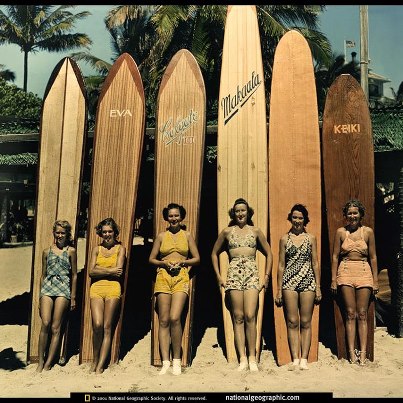
I am a woman who has straddled a multi-generational gap in women’s surfing. I have watched, listened, and learned from 3 decades of shift in women’s surfing (from mother to daughter; from daughter to champion; from daughter/champion to student). The one decade I missed out on, those of our earliest modern predecessors (respectfully delaying discussion, for the moment, about Polynesian Queens who chose who would surf with them at private South Shore Hawaiian breaks), were communicated to me via an oral tradition that was hard to come by, since my elder-mothers rarely spoke with their younger counterparts.
There have been multiple memorials for surfers I have attended. Not one has been for a female surfer. Certainly not for lack of death… but it seems that the female surf story in surf history has been bifurcated in such a way that it has no place in the Pantheon of Surfing. There are multiple reasons for this. One of the most distressing is that female surfers have, with a few notable exceptions, chosen to step away from their rightful place in the Pantheon, disappearing into oblivion… but why?
The most easily accessible reason is that some editor or publisher told the female surfer that their story was just not marketable. I can’t speak enough to how often this particular and very gender-biased “reasoning” has deleted an inspirational story. The readership of women has been under-valued and under-represented for far too long. This is not a surf-centric issue.
If one is raised or indoctrinated with the male perspective of what surfing is, as a girl, one has a choice to make: 1) fit the mold 2) exit the mold 3) completely alter the mold.
Well, to what extent any role models have existed to represent the third alternative, I cannot speak, though I am hesitantly optimistic about some alternatives I have seen popping up lately (thanks to a more democratic means of viewing surf culture and the demise of Big Surfing) that revolve very strongly around feminine creativity and artistry.
A History of Women’s Surfing?
The history of women’s surfing has not been written. There have been story lines, biopics, portraits, and photographs, but a concerted effort to bring to the monolith that is Women’s Surfing, some detail, has not yet been written. Quite often, when a piece of this history is presented, there are voices that rise up and point to divergent avenues, alternate story lines, and question the veracity of what is being presented. These are the women who lived these times and they are quite often swatted away by those who don’t grasp that the stories, even of icons, have layers and complexities that are woven with and amongst the stories of untold others.
I have recently had some amazing conversations with women who I respect deeply and who have inspired me during various stages in my life and “career” as a pro-female surfer… a span of about 28 years at this point.
Like most of these types of lady-surfer-conversations, we conversed in fire escapes, beneath EXIT signs, in non-spaces online and offline where we knew were safe, where there could be no judgment about gender (which so often revolves around looks and age) or sexuality (which is too often a topic of conversation around female surfers).
I feel personally compelled to speak of these things because I know the power of silence and as far as communication is concerned in the realm of surf media, there is a lapse in transmission and reception in the surfing world that is grossly gendered.
Even amongst those well-intentioned males who wish to support women’s surfing, there is a mighty disconnect… what sounds like empowerment to their minds often reads as exploitation. How to explain this without alienating the support we have is a conundrum that is, like so many other aspects of these conversations, complex. Unfortunately, those who ought to be speaking, the women themselves, are not. A culture that cultivates silence for half of its population is not a healthy culture, even if unintentionally cultivated.
A Conversation
Prelude: A dear friend wrote to me about a sample of photos given online of women’s surfing in the 1980s. She experienced so much from all of the ladies represented that her reaction to this photo collage was visceral. It told a story for her that she felt compelled to tell. This is my response…
Dear ___,
The sample given by _____ is not the whole story nor do I feel it is being presented in such a way that history is being rewritten or even written, period… it is just being pointed to, reminding us that there is a history to begin with. This is where we are… nearly without a history altogether (other than oral, and how much do we speak to one another)! I was just asked about how lonely it feels to be a voice for feminism in surfing… and I baulked! ALONE?! My god! There have been tons of us!! But NO ONE KNOWS because the history is disjointed, disconnected, hoarded away in boxes and memories. This generation knows next to nothing about its history. We are at ground zero, our history not being rewritten, simply never having been WRITTEN at all!
What I see is a group of ladies who have been forgotten: success, beauty, pain, trauma, conflict, and all. Stepping away from it slightly, I come to understand that if the details are to be known, there must be a process of discovery, of interest… first, a stoking of a desire to dig deeper into these times and into our foremother’s lives. First, we see a homogenous mass, e.g. “the women of the 1980s”; next, we ask ourselves about the lives of each… really similar to how I first approached you, ____. I wanted to know answers about a time period and, over time, you opened up with stories about your life experiences, but it didn’t happen all at once and we have more personal history than most of those looking back at these times. I also had a mother who told me enough to perk my interest (she, with her own heroines, demons, and struggles… her pro-surfer-humanity).
Who will tell these stories if not the women who lived through these times themselves? How do we develop a lineage of listening with competitive women who are hell bent on destroying each other, competitively, during their prime and find that they are forgotten once time moves past them? When the male surfing world draws together to embrace their legends and make of them heroes, what are we doing as women? Are we drawing together to support our heroines? Or are we clawing at the past, continuing a competitive myopia that demands of The Mother, bloody submission, rather than celebration for her travails? How can we change this, for the future?
How can we heal the undignified mistakes of our past for the cohesion of an open future? It has been 4 decades of this split between lesbians and straight women in the surf industry… how do we bridge this abyss?
Postscript Note to Self: ______ had already moved beyond this emotional space by the time she received my email. The ability of these women to move past the emotional hail-storm of past feelings is inspirational to me! How do they do it?! What strength! More respect for this woman, and those who had to deal with this mentality, as the years pass.
Where the Strength of Women’s Surfing Resides
There are issues that can easily be relegated to the realm of “the women” and there are issues that the entire global community of surfers are awakening to.
Look at any of these global movements that are emerging, be that how the care for Cetaceans has transmuted itself into a humanitarian venture or how Share The Stoke is actually communicating the values of surfing, or how a dear friend took it upon herself to use her Communications degree to alter how Malibu’s landscape was going to be damaged, along with running her Surf Institute, and supporting the values of Philippine friends.
There. Are. More. Women. Than. These.
Another Conversation
More than ever I think subversive voices are becoming important as surfing moves into these areas… your feet on the ground in _______, interaction with the people, and your sharing of stories from there is so important, _____!
I cannot believe that surfers want what the surf corps are doing “on our behalf” and “in our name.” But to really own this, we have to become a community. In this realm, I think women have a unique opportunity to set a standard of community that has only been present within our own gendered corners of surfing. Where we once stood together to support other women (pre-ASP) we are now standing together with men, women, and children of all walks of life, from all over the globe for what we know surfing to really be… what an unexpected evolution of women’s surfing!
End Game
How do we foster and fuel a lineage of women, of daughters, who listen to our stories, who respect what we have to say? How does the history of my mother’s past, and her heroines, get written? How can we bridge the gap between the eccentricities we were once taught to ignore and how the diversity and complexity of these folks helped women’s surfing become what it is today? Simply, why don’t the young ladies of pro surfing know who Joyce Hoffman or Peggy Oki are? And who is to blame if not our own absconding?


Leave a Reply